Saturday, August 14, 2010

August & Antiques in L'Isle sur la Sorgue


Twice a year for the last 42 years, the antiques mecca known as L'Isle sur la Sorgue has hosted an international antique brocante that attracts hundreds of vendors and shoppers from throughout Europe.  The fair fills the city park and flows out along the crystal clear, swift-flowing canal that encircles the town. I was able to make the fair in April -- on a cold, windy day threatening rain -- but I'm going to miss the one going on this weekend.  If you are anywhere in the area around Avignon, Marseilles or Aix-en-Provence, head for L'Isle sur la Sorgue.

There are about 300 permanent antique dealers in L'Isle and that number more than doubles every weekend when the village holds a very well-known antiques flea market on Sunday. During summer months in the market, you'll hear nearly as much English, Italian and German being spoken as French. The selection of antiques is both expansive and expensive -- if you're used to shopping in lesser known brocantes or vides greniers as I am.  Still, you can still find some excellent items at fair prices if you're patient. Like any market in Provence, you want to arrive early for the best deals.  The vendors buy from each other before the customers arrive and being part of those first sales yields bargains.

An old seed advertisement
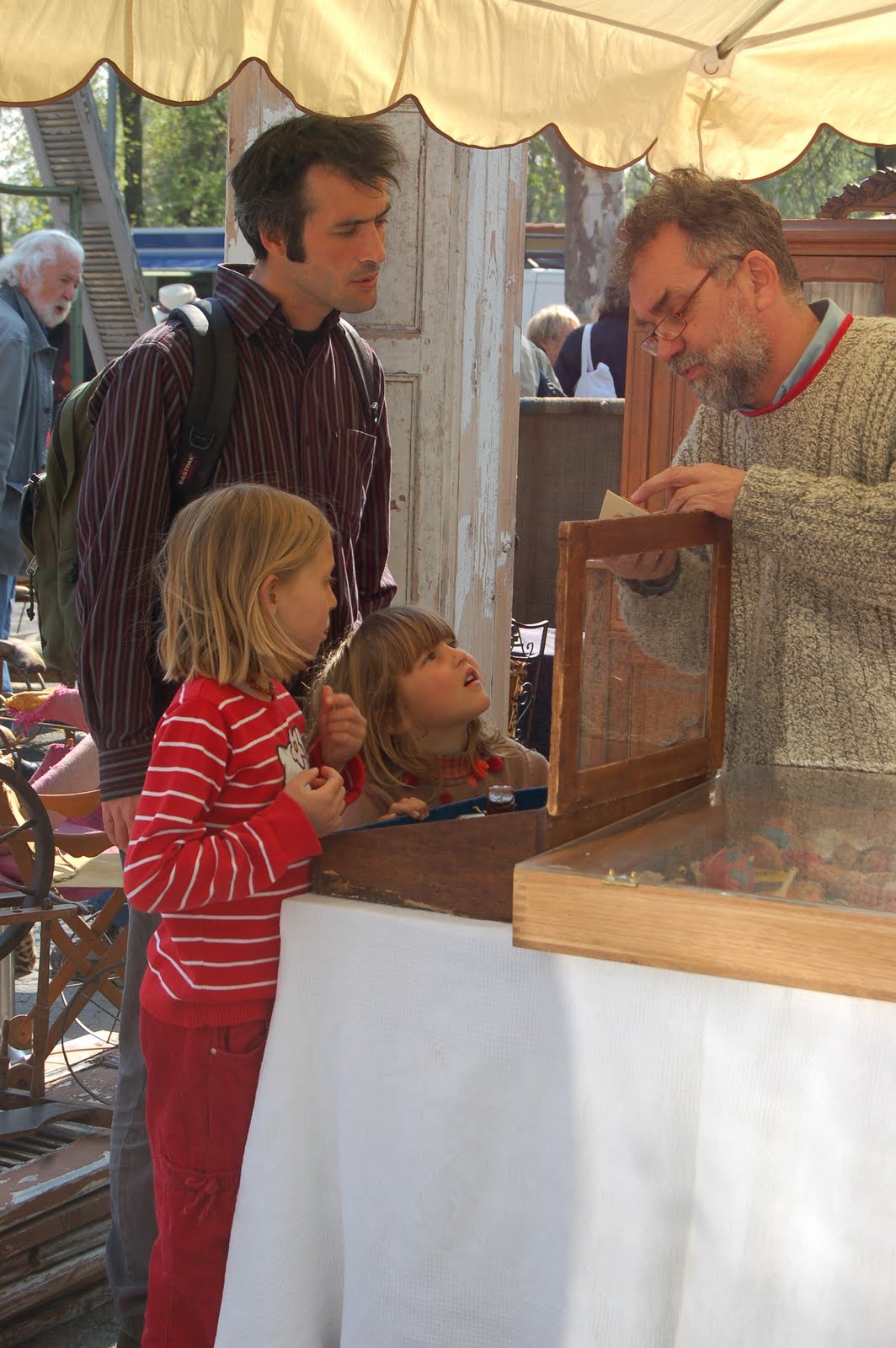
L'Isles sur la Sorgue Antique Fair last Spring
Last April, I bought a half-dozen hemp grain sacks dating from World War II in excellent condition at about 10 euros each ($13) to someday be used for upholstery but now being used to store linens.  I wish I'd bought the surplus 1950s Swiss Army blankets in steel gray with red crosses on them, selling for about 60 euros ($75). I don't have the blankets but I do have the memory of the amusing exchange I had with the vendor when I expressed the wish that the Swiss military made blankets in queen size. He laughed so hard he almost gave me one.  Almost. Things were busy in the military surplus tent, but I heard a number of vendors complain that sales were slow because of the economic crisis in Europe.  The economic outlook seems a bit better now, but my friend who sells in several other local flea markets says summer is never great for business.  Tourists come in droves, but few are interested in buying any larger items to take home. If you're the exception and you're willing to schlep your purchases home, you should be able to negotiate a very fair price this time of year.    
Never too early for a glass of wine
The Sunday flea market in L'Isle dates to 1966, when just 14 vendors gathered to sell old furniture, paintings and antiques on a Sunday afternoon. A little local publicity helped make the event a great success and it continued to grow gradually over the years, picking up steam in the 1980s with an increase in tourism, continuing publicity and a strong dollar. Over the last decade, L'Isle has seen a 128% growth in sales by the permanent antique dealers and those working the Sunday market.  

Sitting in traffic or searching for a place to park on Sunday morning, it's hard to remember that L'Isle sur la Sorgue was once a tiny village of fisherman.  It was an island surrounded by marshlands that were drained by the construction of the canals that now criss-cross town.  Tourist brochures refer to the town as the "Venice of the Comtat" and in the 12th century, water wheels were built along the canals to grind flour. Later, these were used for the silk and wool industries, which made the town extremely rich. (More on the silk trade in a later post.) A few of those 72 original waterwheels survive today. And fishing for trout is still very popular on the Sorgue -- although, perhaps, not as popular as fishing for bargains. 


Friday, August 13, 2010

Armchair adventurer


I confess. I'm addicted. If I buy one more Côte Sud, Elle Deco, Maison Francaise, Arts & Décoration, Ambiances, Campagnes Décoration, Mon Jardin or any other French decorating or art magazine, I'm going to need another house to store them in.  With magazines perched on coffee tables, bookshelves, even stacked under the bed, I've run out of space. Now, I've begun now to collect links to blogs on design, especially French design, with the same obsession the caused the overflow of magazines.  You can't hold a link the way you can hold the slick paper and satisfying weight of a magzine, but you don't have to dust them, either. This fascination with the decorative arts isn't new.  In fact, I've been interested in design, including French design, for as long as I can remember. 


I suspect, if I'd been better in math, I would have been an architect.  When other little girls were snuggling baby dolls or playing house, I was designing mine -- drawing floorplans with crayons and imagining castles with rainbow roofs. 
Salon, Le Clair de la Plume
As an adult, this love for interior design and decorative art translated into serial home buying. I found great fun in the first house I ever bought -- a plain wooden box -- that I gussied up with a pretty interior and flowery garden, sold at a nice profit to buy another one and begin decorating again.  Six houses and 18 years later, I'm still having fun and in the three years since I bought my home in France, I've just had a blast filling it. 


Furnishing a house is less about acquiring objects than it is about acquiring knowledge.  I've bought  little, but learned much.  I've learned to identify French furnishings by name, the way some people can identify birds -- the delicate Saint Hubert, the diminuitive bonneterie, the difference between a Bergere, Voltaire and Louis XIV.  I've discovered an ancient, Rube Goldberg-style factory in Provence where a brother and sister are the last to maintain a 19th century tradition of hand making brightly-hued coconut fiber rugs. I've met painters and potters and professors of decorative arts who were kind enough to explain the influence of nature in 17th and 18th Provencal architecture. Being an eager, appreciative student seems to bring out the teacher in everyone I meet. So the search for a single chair becomes an excuse to meet people who share my passion,  a chance to explore new corners of Provence, a key to learning more about the history and culture of France, an adventure.  I take my time; each piece has a story.  And I have many more stories than any single house could ever hold. 


Provence is a paradise for people passionate about decorative arts.  You don't need to be in Paris to have access to fantastic museums filled with beautiful objects and generous curators willing to share their knowledge. There's no better place for open-air markets, amazing out-of-the-way antiquaires and brocantes, the serendipitous greniers vides.   In the next few posts, I'm going to share some of what I've learned and hope that I'll hear from others who share my interest in art, decor and my deep affection for France.
.

Tuesday, April 27, 2010

Patriot Act Fallout: More Americans Giving Up Citizenship


My run-in with the so-called Patriot Act began with a leaky roof. 


I'd been told that "all old houses in France leak," so I wasn't shocked when water began flowing into the house from my lovely roof terrace. It need to be fixed. 


About two months ago, I started trying to transfer a few thousand dollars to France for the repairs. I called the currency trading company in London that helped me transfer money to buy my house, Currencies Direct, and was told rather brusquely that they no longer worked with American clients. Apparently, last November, some measure within the Patriot Act took effect that barred the transfer of funds. Or made it impossibly cumbersome and potentially risky for currency traders. At least that's what I was told. To move the money, I'd have to prove I "lived" in France. My bank in Texas also was reluctant to wire the funds -- despite the fact that I needed less than $10,000 and I've been an excellent customer for about a decade.  


Ultimately, I figured it out but the experience made it clear that the U.S. Government is seriously tightening the screws on the freedom of its citizens.  I found the experience more than just a nuisance, I found it frightening.  So I was not surprised when the New York Times ran a story today describing the myriad problems that are so serious they're causing expatriate Americans to renounce their citizenship.  The article says expats are taking such a dramatic step based on financial issues, not politics.  I'm not so sure. What is clear is that there is a lot of confusion and fear among American expatriates and even those, like me, who live only part of the year abroad. And it is clear that the Treasury Department is ignoring official requests for relief for Americans living abroad. I wonder why?


I'd be very curious to know what other people are experiencing. Are you having trouble with your U.S. bank, with transferring funds?  What are you hearing about the experience of others? 

Wednesday, April 21, 2010

Sunday, market day

Sunday morning is no time for lazing about. Sunday is flea market day, and the goal is to get out the door after one small coffee for a morning drive to some nearby village and eager vendors with all sorts of fascinating things to sell. There are several kinds of outdoor flea markets, fancy schmancy antiquity markets, more modest brocantes and the truly modest vide greniers. Brocantes can be fancy or modest, large and small, with everything from beautiful carved bonnetiere to old faience and ancient tools.   Vide Greniers -- literally, emptying the granary -- are closer to what Americans might think of as a neighborhood yard sale but with vendors whose families may have been in the neighborhood for centuries, collecting some pretty wonderful old stuff the entire time.  Vide Greniers are much less pricey than the other fleas and I've bought everything from a used iron for 1 euro to fine  hand-embroidered linen pillow cases that would cost four times more in a brocante. 

Professional antique dealers with fancy shops get to the brocantes and vide greniers early before things have been picked over and the heat of the day has set in. In the summer, tourists start pouring in around 10 so the goal is to get there around 8, earlier for some markets like Villeneuve-les-Avignon where everything is out and buyers already are negotiating full force by 7.

Every market has its own style and feeling and every object has its story so just asking, "what's this?" can generate an entire history lesson or a glimpse into an mostly forgotten way of life.  Last weekend I saw my first silk bobbins, lovely carved wooden arcs of less than 3 inches shaped like waves. I purchased two with colorful silk thread still wound tight and ready for use in making a pinafore or bustled skirt. The bobbins date from the Industrial Revolution and when I asked about them I was lucky enough to hear a long history of the silk trade, the worms raised in the Ardeche and the flourishing 18th century silk industry in Lyons.

Often, I just wander through the markets listening to conversations and watching the interactions between buyers and sellers, couples, friends and families, all out shopping for the day.  But if I'm not careful, I also can wind up with an empty wallet by late Sunday afternoon.  So last weekend I set of goal of not spending for any single object more than I'd spend on seeing a movie. Here's what I brought home.  Christmas presents?  Perhaps, if I can bear to part with them.  


A tiny, perfect porcelain vase made in Limoges.  My friend Guy said it was for a "rose d'amour."  He was making fun of me, but I think he's right.  It's just perfect for a single, tiny tea rose from someone you love.


A funky, handpainted souvenir, probably from the 1920's and found here:


There were two, and the other one said "Souvenir de Monte Carlo."


Six yards of 19th century, handmade lace.  I've been buying a lot of lace lately and am going to do a future post on what I've learned. Regardless, it's just so pretty. Stitch this on anything and it would be elegant.

A plastic piggy bank in the form of a French post-office box.  A dealer threw this in as a gift with another small purchase. Very silly.  Love it.

A pretty glass bottle with tiny red flowers painted in relief around its fat belly and a bright green line around the rim, like a choker around a pretty girl's neck.

A tiny Berger pitcher, big enough for a Pastis for one. 


A hand-painted, blue and white vase from Moustiers, with a bird on one side, a musician and bird on the other and little bees and flowers on the top.


A pair of 18th century cast-iron locks from an old commode or armoire. I dug through a large tin box containing dozens of other patterns before I picked this one. They were all pretty and I learned you can use these locks to help date a piece of furniture.  I'm going back to that antique hardware vendor -- an woman of about 85 in a well-used straw hat who drives a hard bargain -- to learn more about the lovely locks she sells.


A tart baking dish from Luneville, which has been making faience in this same pattern for about 300 years. The mark on this one, which looks brand new, is from around 1922 -- which is new by brocante standards.

With all of these objects and a few more on the back seat of the car, I drove home from the markets through a valley filled at every turn with wisteria and the first pale leaves of spring. An altogether satisfying Sunday.


Monday, April 12, 2010

A Sunday Drive in Early Spring

It has been an unusually cold and rainy spring here.  The mimosa on the village square that has usually lost its blooms by March has lasted all the way into mid-April. That tree is such a brilliant and definite yellow that since I first saw it, I've never been able to hear the word "yellow" without thinking of it.

I've been putting my vases of tulips and ranunculus on the windowsill at night to keep them fresh and turning the heaters on first thing in the morning before bundling up to go downstairs to make coffee. All around, the twisted branches of the plane trees and vines seem especially bare now that wildflowers are blooming at their feet and they seem ready to get dressed. By this time last year, the vines were fluffy with pale green leaves and I was sleeping with the windows thrown wide open.

So I and my friend visiting from Italy were especially grateful Sunday for a warm and sunny day that encouraged us to hit the road. The excuse were visits to the flea markets in Roix and Le Tour, but all along the way we meandered, stopping to admire an almond tree so white it seems to glow or shoot pictures of fields blanketed with eye-popping blue flowers that made me feel a little better about missing the bluebonnets this year in Texas (which, I hear, are stunning after a couple of pretty thin years).


Then, alarmingly, it was 1 p.m. and we were hungry and if you don't find a place to eat in southern France before they stop serving at 2 on Sunday then your options for food -- like those bluebonnets in years past -- are thin on the ground.  We raced for the nearest town, Isle-sur-la-Sorgue, which I normally try to avoid. Isle is a famous tourist destination and there are times in the summer when you hear more English spoken than French. The Sunday market is large and varied and includes a substantial number of antiques vendors, befitting a town whose economy is built on selling very nicely polished items at sky high prices. In the summer, you can't park, can't find a table for lunch, can't get through the crowds and anyway, why bother when there are so many wonderful places to go?  But this Sunday in Isle reminded me of why it became such a popular destination in the first place.

We ate beside the canal that encircles the island ("isle"), the water glass green, swiftly flowing and transparent, allowing a view of small fish and graceful water grasses.  The sun was warm, there were relatively few tourists, the crowd at the cafe was relaxed and lively, and as the vendors took down their tents and came in for lunch, the joking and wine increased in volume.  Then the music started, a committed accordionist of the old school providing drama, humor and the perfect soundtrack for this little piece of paradise.

Finally, it felt like spring.

Thursday, April 8, 2010

A drunk of discerning taste

I'm quite sure I'm not supposed to enjoy the advances of an anonymous drunk, particularly when he's already "dans la jus," as they say, at 11 on a Thursday morning and he's speaking to me rather loudly across a parking lot. And there is just no doubt about his state since the wind coming from his direction is saturated and I smell stale red wine even before I hear him and realize he's addressing me. But what he lacks in discretion, he makes up for in poetry. "Did you know you are beautiful, madame?" he asks, as I pass on the way to the car carrying a basket of vegetables and olive oil from the Nyons market.  "Yes, yes," he insists, "you are a woman of rare beauty. Rare beauty."  My birthday is later this week.  I'll take the compliment. I smile all the way to the edge of town.

Pictured here, my preferred tapenade vendors.  Worth a special trip in to the market on Thursdays.  Nyons is famous for anything olive -- olive oil, tapenade black and green, with garlic and without, olives cured in every fashion, in bags, bottles and boxes.  Yum.

Friday, January 8, 2010

Solde! Sold!

In the States, there seem to be sales going on all the time.  Everything is for sale and on sale. Stores like TJ Maxx and Marshalls make finding a great bargain routine.  But in France, sales are an annual ritual, overseen by government authorities, awaited with great anticipation and especially exciting because they're over so quickly.  The American shopping experience is like a marriage, ongoing and predictable, whereas the French sale is like an affair, exciting and over before you know it.

There are only two official sale dates -- the summer sales (Soldes d'été) and winter sales (Solde d'hiver).  Dates for both are set each year by the Minister of Economy, Industry and Employment.   I nearly always take advantage of the summer sales when items from dishtowels to Dior are reduced 30%, 50% and sometimes 70%. Sales begin on the same day across the entire country, but end dates are set by each department after local government officials confer with local merchants.  They last about five weeks. It is all very organized with shops often closing down for a day or two beforehand to prepare, the clerks moving behind glass or ropes re-stacking stock and dangling colorful banners and boxes from the ceiling marked with the amount of the discount.

This year's winter sale began at 8 a.m. Wednesday, January 6th, and in most places it will end around the February 10th.  There's often a bit of a crush to find the best bargain in the first few days and for the biggest department stores, the winter event can represent a quarter of total annual sales. Pierre Pelarrey of Printemps on Boulevard Haussmann told Radio France Internationale on Tuesday that his department store was expecting 140,000 eager Parisians on the first day of the sale.  Other retailers said the recession in France means people will be especially eager to shop the bonnes affaires this year.

Which is to say, if you are in Paris this month, avoid the sidewalks around Printemps, Galeries Lafayette, Le Bon Marche or BHV over the next few weeks -- unless you intend to join the fun.

AP Photo by an old colleague in the Paris bureau, Lionel Cironneau.